Over the past year, there has been a groundswell of evidence on the benefits of brain training for dementia—and study results revealed today add yet another surge.
First, last October scientists published results from the INHANCE study showing that using BrainHQ exercises turned back the clock on brain aging by 10 years by increasing the production of acetylcholine, a key brain chemical that declines with age, and plummets with Alzheimer’s. It was the first time anything has been shown to do so.
Then in February, a 20-year follow-up to the landmark ACTIVE study showed that using a certain speed training exercise (now only available in BrainHQ) reduced Alzheimer’s and related dementia diagnoses by 25%. Once again, this was a first-ever result: no other pill, program, or practice has been shown to prevent dementia in this way.
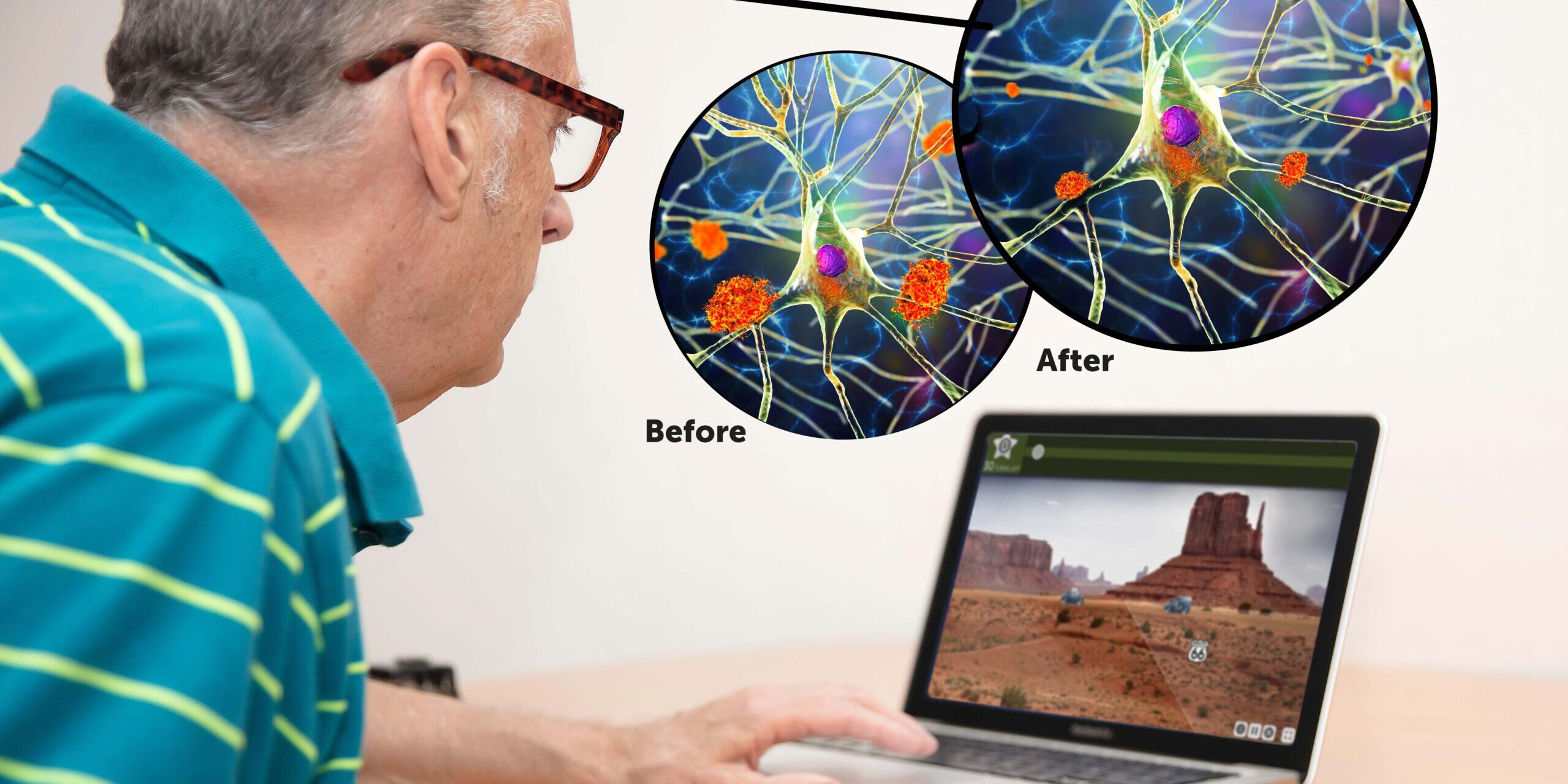
And today, comes the next breakthrough—results of the ENACT study were presented at the Alzheimer’s Association International Conference in London. They showed that training with BrainHQ exercises improved the levels of a biomarker for Alzheimer’s disease.
To understand the importance of this result, let’s talk about how doctors currently define Alzheimer’s disease. For a person to get this diagnosis, a doctor has to see two things. First, the person has to show significant cognitive decline that causes problems for their ordinary activities of living—giving them the diagnosis of dementia. Second, the person has to have substantial buildup of “plaques” —abnormal globs of a protein called amyloid—in the brain. Then the doctor can make the diagnosis that they have dementia of the Alzheimer’s type, or Alzheimer’s disease for short.
If a person has significant cognitive decline but no amyloid, then they may have dementia, but not of the Alzheimer’s type. And if they have a lot of amyloid plaques in the brain but no significant cognitive decline, then they don’t have Alzheimer’s disease.
In older days, the only way to confirm that a person had amyloid was to examine the brain after the person had passed away. So, doctors would commonly make a diagnosis of “likely Alzheimer’s disease” because they couldn’t be sure that the dementia was associated with amyloid until they could directly look at the person’s brain.
Over the past few years, scientists have used a PET brain imaging technique to see and to measure amyloid levels in a living person’s brain. That’s been an amazing breakthrough! But it’s expensive, and it requires a visit to a medical center with an advanced brain imaging system—so it’s not yet broadly available.
More recently, researchers have developed ways to measure amyloid with a blood draw, just like cholesterol can be measured with a blood draw. This is a really exciting development: it opens the door for people to test for Alzheimer’s risk as easily and as regularly as they test for high cholesterol. And here at BrainHQ, we’d like to think that if a person found out that they had an elevated risk for Alzheimer’s disease, they might take action to improve their brain health—including training with BrainHQ.
The ENACT study used one of these new blood tests for amyloid to determine if BrainHQ training changes amyloid levels.
And the great news is it did! People who trained with BrainHQ showed a significant improvement in their amyloid blood test results—suggesting that the amyloid plaques in their brains were reduced through BrainHQ training. The effect was significant when compared to the control group, who trained with ordinary computer games like Word Search—signifying that the specific brain-plasticity-based effects of BrainHQ training drove the benefit.
One interesting twist in the results was that the effect was significant for men, but not for women. That might be because the study needed to be bigger to reliably see the effects in both groups. Or it might be because there are differences in the basic biology of how amyloid works between men and women (a number of scientists are working on this topic).
“These results may surprise a lot of people,” says BrainHQ’s CEO Dr. Henry Mahncke “They may not think that computerized brain training can have a direct effect on a brain biology. But,” he adds, “that’s the secret of brain-plasticity-based training. BrainHQ exercises directly rewire the brain—and so of course we can expect benefits like these. Together, these three studies tell a coherent and important story of a major evolution in our thinking about Alzheimer’s. They reveal the biological mechanisms plasticity-based brain training use to slow and even reverse cognitive aging, and deliver some protection against dementia.”
And that’s great news for everyone who wants to take steps to keep their brain at its best!