
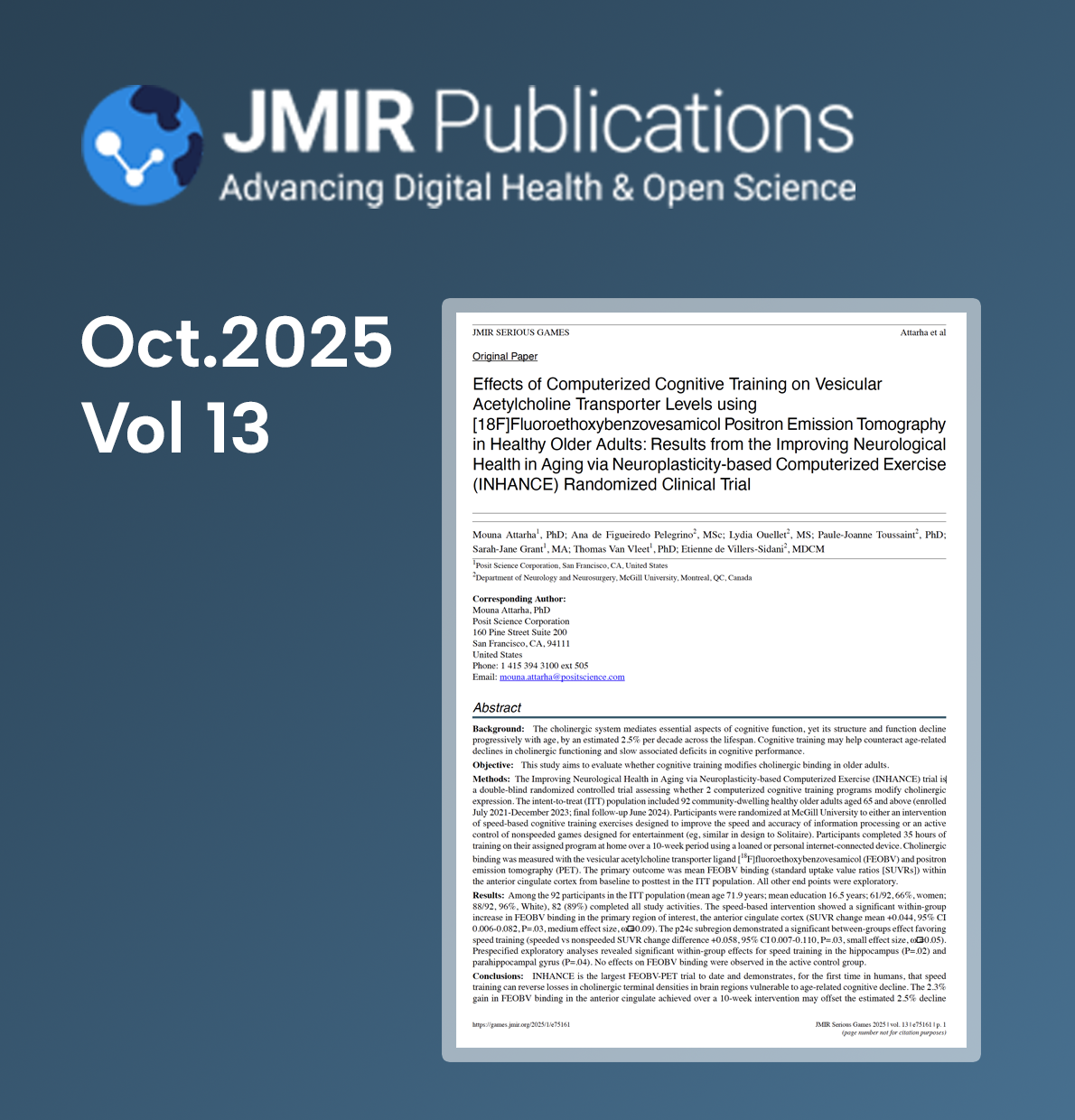
The INHANCE brain imaging study was conducted by researchers at McGill University in Canada and funded by the National Institutes of Health. The study showed—for the first time in humans—that the brain’s chemical system can be strengthened by a specific form of online brain training, effectively reducing age-related cognitive decline by about a decade. The specific chemical the researchers tracked was acetylcholine.
Acetylcholine is a molecule made in the brain that acts as a neuromodulator, a chemical that controls the overall health and function of the brain. When you pay attention to something, your brain releases acetylcholine. This tells your brain that something important is going on, and it enables your brain to rewire itself (a process known as brain plasticity) to learn and remember what happened.
Acetylcholine is one of the most vulnerable systems to aging, declining roughly 2.5% per decade. This decline contributes to reduced attention, slower learning, memory deficits, and executive function challenges, and it is a hallmark of dementia-related brain changes.
Current medical treatments for cognitive impairment and dementia do not restore the brain’s ability to produce and release acetylcholine. The INHANCE study is the first non-pharmaceutical intervention to show that the right cognitive training can naturally and meaningfully reverse acetylcholine decline in humans.
The participants in the INHANCE study trained on two exercises in BrainHQ: Double Decision and Freeze Frame. Other studies—particularly the ACTIVE study—have shown that Double Decision can improve cognition, health, and daily function, and even reduce the incidence of dementia over 20 years. Double Decision trains the brain to process information faster and more efficiently. Freeze Frame works synergistically with Double Decision by engaging the brain chemical systems involved in attention. The technology behind Double Decision and Freeze Frame are only available in BrainHQ, and not in other cognitive programs or brain games.
Learn more about Double Decision and Freeze Frame.
In the INHANCE study, participants were randomly assigned to brain training for ten weeks for 30 minutes a day, or to a control group that spent an equal amount of time playing casual online games.
The INHANCE study met the requirements for gold-standard research. That means it was:
Funded by an unbiased, reputable organization: The INHANCE study was funded by the National Institutes of Health, National Institute of Aging.
Conducted at an academic site: Neurologists at McGill University conducted the brain imaging and analyses to ensure reliable, independent results.
Prospective: The study enrolled people and then followed them over time. This is a better study design than looking at what has happened to people in the past, because scientists can measure outcomes (like amount of cognitive training or cognitive function) directly, rather than having to rely on people’s recollection of what happened to them years ago.\
Randomized: The study randomly assigned people to one of two cognitive training groups. This ensures that the benefits seen in a group are only the result of being in that group, and not the result of a scientist putting all the people who share a characteristic (like they have good cognitive function, or they are friends) into one group.
Controlled: The BrainHQ training was compared to an active control group with other exercises to isolate the “active ingredient” driving benefit from cognitive training.
Blinded: To prevent bias, researchers who conducted the brain imaging scans and cognitive outcomes did not know which group participants were in. This helps make sure that those researchers didn’t unconsciously give higher scores to people doing the cognitive training program, in the hope the study would be successful.
Participants completing the BrainHQ exercises showed a 2.3% increase in cholinergic binding in the anterior cingulate cortex, a key brain region for attention, memory, and executive function. This gain might sound small—but when it comes to cognitive function, it isn’t. It effectively offset a decade’s worth of age-related decline.
Memory-related regions also improved significantly, with a 4.7% increase in the hippocampus and a 5.3% increase in the parahippocampal gyrus. These areas are critical for memory formation and retrieval and among the earliest to show cognitive decline.
The active control group, which used casual online games, showed no change in any brain region.
Summary of core findings
- Brain chemical systems are plastic: The chemical system which is vital for attention, learning, and memory can improve in adult humans. This is the first demonstration of neuromodulatory network plasticity.
- The type of training matters: The particular training from BrainHQ specifically improved cholinergic health, while ordinary computer games did not.
- A little goes a long way: Just 10 weeks of training produced improvements equivalent to reversing about 10 years of natural age-related decline in cholinergic function.
- We now understand the how: These findings reveal a biological explanation for earlier results on the benefits of BrainHQ to brain health and cognitive function. Of note, the ACTIVE trial, which also used the Double Decision exercise showed a 25% reduction in the incidence of dementia over 20 years. This reduction in dementia is likely driven—at least in part—by improved acetylcholine function in the brain.
You can read the INHANCE study published here. Learn more about the study on the BrainHQ blog, or take a look at the stories on NPR, CNN, NBC, or Psychology Today.