
With 2,832 participants, the Advanced Cognitive Training for Independent and Vital Elderly (ACTIVE) study is the largest study on cognitive training with standardized outcome measures ever performed. Funded by the National Institutes of Health and led by researchers at six academic research universities (including Johns Hopkins, Penn State, and the University of Alabama at Birmingham), the ACTIVE study proves that healthy older adults can make significant cognitive improvements and lower their risk of dementia with appropriate cognitive training and practice. It also demonstrates that BrainHQ training drives more and longer-lasting improvements than other types of cognitive exercise.
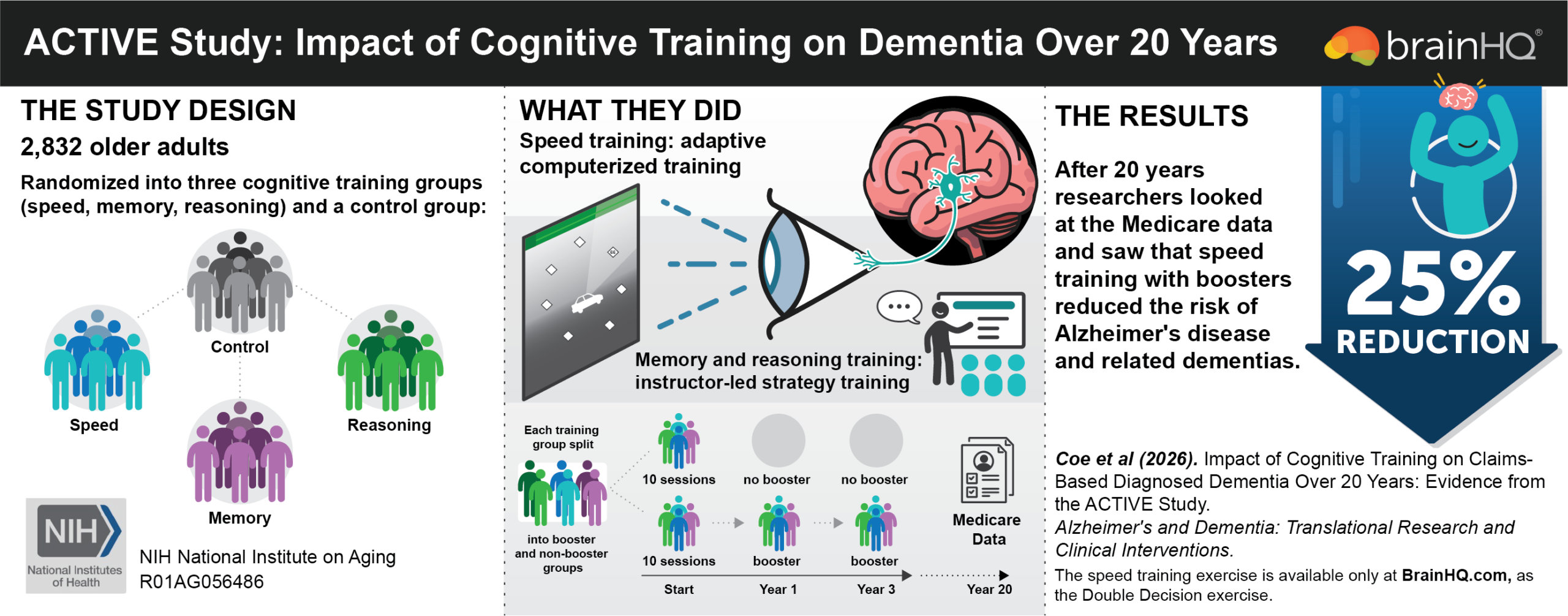
The ACTIVE study, begun in 1998, was designed to evaluate three different types of cognitive training: one that focused on memory, one that targeted reasoning, and one that exercised speed of processing (called “speed training” in the study). The study was conducted at six sites across the United States, and all of the participants were healthy adults aged 65 or older. Each cognitive training group was compared to a group of people who did not do specific cognitive training. The people in the training groups trained for 2 hours per week for 5 weeks (10 hours total), and then about half of them did additional “booster” training a year later and then again three years later. Researchers followed participants for twenty years to evaluate the long-term effects of training.
The speed-of-processing training that ACTIVE study participants used was an earlier version of the BrainHQ exercise Double Decision. In Double Decision, the user has to spot a target in the middle of the screen while simultaneously noticing a target in the periphery—even when they flash on screen very briefly. Over time, the brain speeds up, and is able to process the targets more and more quickly.
To make sure Double Decision retained all the scientific accuracy of the original exercise used in the ACTIVE study, our science team worked hand-in-hand with the original developers of the exercise. The exercise is only available in BrainHQ.

All three types of cognitive training tested in the ACTIVE study resulted in cognitive improvements after the initial training period, but participants who used the speed training exercise (now available in BrainHQ as “Double Decision”) experienced the best results overall. According to the study, 87% of the participants who used the speed training showed meaningful increases in the targeted cognitive ability, while 74% of participants who used reasoning training and 26% of those who used memory training showed improvements.
Importantly, the benefits of speed training generalized beyond the targeted cognitive ability. People in the speed training group showed protection against declines in their abilities to live independently on their own (which was also seen in the other cognitive training groups). Uniquely to the speed training group, people showed protection against the risk of serious decline in health-related quality of life and the risk of the onset of depressive symptoms. Furthermore, people showed a significant improvement in driving safety: their risk of an at-fault car crash was nearly halved. Finally, people who trained the most (those in the booster groups) not only improved their speed of processing, but also showed improvements in everyday speed—such as reading an ingredient list or looking up a phone number—more easily and quickly.
At both 5-year and 10-year follow-ups, ACTIVE study participants who used the speed training in BrainHQ continued to show significant cognitive improvements, even though they were not training continuously across that time. This shows that a person doesn’t need to continually do brain training to see and maintain benefits—a person can take breaks and then come back to brain training to sustain benefits.
A 20-year follow-up of ACTIVE published in February 2026 reviewed the Medicare data of each ACTIVE study participants. That study found that those who did the speed training with boosters (a total of about 18-22 hours of training over three years) showed a 25% reduction in the risk of getting Alzheimer’s and dementia over the 20-year period. No benefit was shown from either the memory or reasoning training groups.
Taken together, the ACTIVE results demonstrate that while cognitive training can have tremendous benefits, not all cognitive training is equally effective.
The speed training exercise used in the ACTIVE study, now called Double Decision, is available only through a subscription to BrainHQ.
- Improvements in speed of processing abilities
- Improvements in everyday speed (for the booster group)
- Protection against declines in instrumental activities of daily living—that contribute to the ability to live independently—equivalent to 2-3 years of benefit.
- 35% reduction in risk of serious health-related quality of life decline, higher self-rated health
- 38% reduction in the risk of developing depressive symptoms, and a 30% reduction in risk of increasing clinically important depressive symptoms
- 48% reduction in the risk of at-fault car crash
- 25% reduction in Alzheimer’s and dementia over 20 years
- Multi-center: Six trial sites were involved, which helps show that the results were reliable (and not unique to one place or one scientist) and can be generalized to apply to a broad group of people.
- Prospective: The study enrolled people and then followed them over time. This is a better study design than looking at what has happened to people in the past, because scientists can measure outcomes (like amount of cognitive training or cognitive function) directly, rather than having to rely on people’s recollection of what happened to them years ago.
- Randomized: The study randomly assigned people to one of the cognitive training groups or to the control group. This ensures that the benefits seen in a group are only the result of being in that group (doing that cognitive training), and aren’t the result of a scientist putting all the people who share a characteristic (like they have good cognitive function, or they are friends) into one group.
- Controlled: The cognitive training groups were compared to a control group that did no cognitive training. This helps ensure that the benefits seen in a cognitive training group are not just due to getting practice on the cognitive test.
- Blinded: The scientists measuring cognitive function were not told which group a study participant was assigned to. This helps make sure that those scientists didn’t unconsciously give higher cognitive function scores to people doing the cognitive training program, in the hope the study would be successful.